
RESEARCH NOTE · RN-04 · SEPTEMBER 2026
Where the MDF Went
The curious persistence of unspent marketing money.
Paul Cunningham, Managing Director
ACE lens: Analytics (performance: how are we doing?) · Value Proposition (Diamonds) and Technology (Spades) · Execution Engine, measure
Channelscaler, a firm that sells software for managing market development funds (MDF) amongst many other valuable processes, says that 41% of vendors’ MDF goes unused each year, and explains this as friction in the process that runs it.
I know from experience this friction certainly exists, but look at the accounts of the vendors themselves and a different perspective emerges. For most, MDF is deducted from revenue the moment a sale is booked, not when a partner spends it; an estimate of how much will never be claimed is built into that deduction from the outset; and whatever is left unclaimed simply stays where it landed, on the vendor’s books.
The friction is real enough. So, it turns out, is the incentive to leave it in place.
Research Note · RN-06 · October 2026
01
No independent view exists of what share of MDF goes unused; the only two figures with a disclosed sample come from a firm that sells the software to fix it.
Seven published figures put the unused share between 41% and 70%; four originate with MDF, co-op or PRM platform vendors, and two with analysts. Only Brandmuscle’s studies (48% in 2016, 46% in 2022) show their working. Channelscaler’s own poll, worked through on its own numbers, implies something closer to 21% unused among those able to answer, not 41%, and a quarter of the respondents could not answer at all.
02
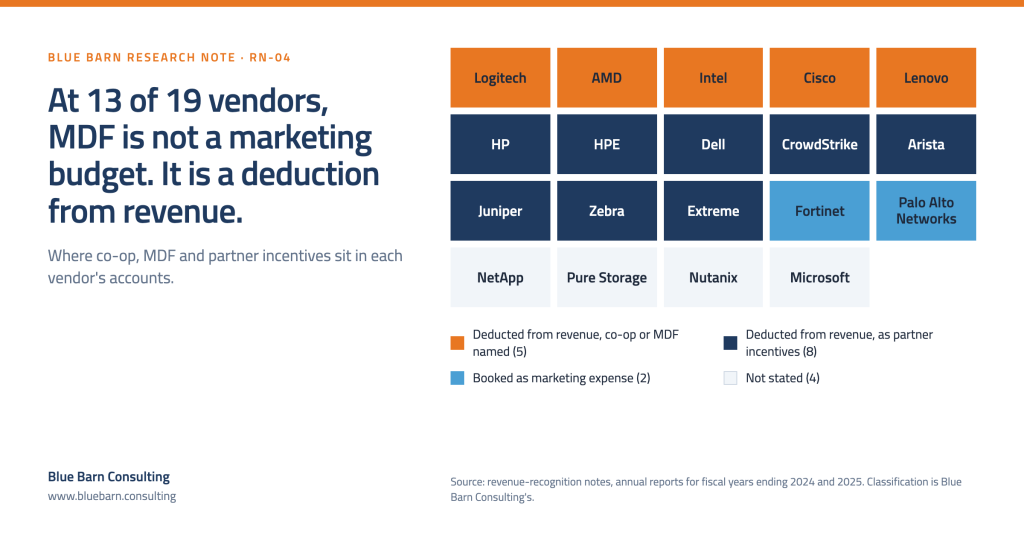
In the accounts, MDF is not a separate budget line. It is a reduction of revenue. Thirteen of nineteen vendors examined treat co-op, MDF and partner incentives as variable consideration, deducted from revenue at the moment of sale; two book them as an operating expense; four say nothing on the point. Logitech, the sole vendor to disclose the figure outright, charged $258m to its co-op allowance in fiscal 2025, 5.7% of revenue, and states plainly that it accounts for ‘breakage’ as part of variable consideration, an estimate built on historical claim behaviour and each programme’s terms.
03
The MDF a channel chief can see is the smaller half of the MDF that exists. At Logitech, 85% of total advertising and marketing spending is booked as a deduction from revenue and only 15% surfaces as an expense; three years earlier the split ran 62/38. AMD carries $1.65bn of accrued marketing programmes on its balance sheet; HP’s equivalent line, styled “sales and marketing programs”, stands at $3.1bn. None of this appears in any sales-and-marketing ratio, nor in any published benchmark of partner-marketing spend.
Research reviewed
Channelscaler, The State of MDF in 2026 (webinar polling, January 2026); the revenue-recognition and accrued-liability notes of nineteen vendor and three distributor annual reports for fiscal years ending 2024 and 2025; Microsoft partner incentive claim rules; seven further published MDF-utilisation figures, 2016–2026. Financial data relates to periods ending on or before 31 December 2025.
Bottom line
The unused-MDF figures the industry reports either have no traceable method or come from the people who offer solutions. The vendor filings show why it persists: co-op and MDF are contra-revenue with breakage/wastage built in, so the vendor’s finance function is ‘paid back’ for every claim a partner does not make.
Download now
Enter your details and the PDF will be sent to your inbox.
We will only use your details to send you Blue Barn research. No lists, no sales calls.
Want to talk through what this means for your programme?
Book a 30 minute slot with Paul