
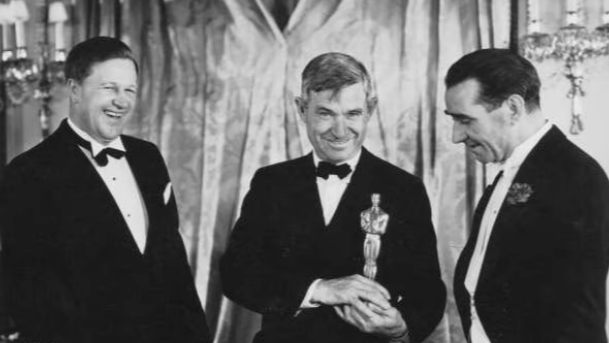
At the 1934 Oscars, Will Rogers opened the envelope for Best Director and called out “Come up and get it, Frank!”
Frank Capra stood up and set off for the stage. The winner was Frank Lloyd.
Capra described the walk back to his table as “the longest, saddest, most shattering walk in my life”, which anyone who has ever sat at a round table of ten in a hotel ballroom waiting for a category will recognise as only slightly exaggerated. He won the next year, and later ran the Academy for four terms. The movie industry did not hold the walk against him. It rather liked him for it.
I’ll be taking a seat at one of those round tables tonight, at the Park Plaza on Westminster Bridge for the inaugural Channel National Awards (or the CNAs as they have always been known in their days as the Comms National Awards.)
This year I was honoured to be on the judging panel, which meant a July spent reading 30+ entries across six categories, and I’ve been thinking since about what awards are actually for.
The cynical view is that awards are a marketing exercise. The trophy goes on the website, the photo goes on LinkedIn, and the evening pays for itself in sponsorship. Some of that is true. It is also beside the point.
What the CNA entries showed me
Judging changes your view of awards because you see the raw material. The entries I considered fell broadly into two types, and the difference wasn’t size, budget or market focus.
The first group had written down what they did, why it mattered to the customer, and what changed as a result, with numbers. They had asked their customers to say so in their own words. They had been honest about what was hard. Reading those entries was like reading a good short story: I finished each one knowing something about business – not just their business – I hadn’t known before.
The second group had described their product, listed their features, and asserted that customers were delighted. Some of these were from businesses I know to be very good at what they do. They didn’t score so well, and the reason was not that the judgement was harsh. It was that the entry had given me very little to score.
That is the first thing awards are for. The discipline (and it is a discipline) of entering forces a business to articulate its value in a form that survives contact with a mostly uninformed stranger. Most companies never do that for themselves. The ones that do it well for an awards entry usually find they have also written the first draft of their value proposition, their sales narrative and their next customer story. The entry fee may be free but the exercise is worth paying for.
The community is the other thing
The UK comms and IT channel is a village. It is a few thousand people who move between the same distributors, vendors, resellers and MSPs, who compete on Tuesday and collaborate on Wednesday, and who mostly know each other by first name. That closeness is the channel’s greatest structural asset and it is under real pressure. Consolidation is taking familiar names off the map. Marketplaces are moving transactions to places where nobody shakes hands. AI is arriving faster than most partner firms have decided what to do with it.
An awards night is one of the few evenings in the year when the whole village is in one place, for a reason that is neither a sales pitch nor a crisis. People who spent the year competing applaud each other. Deals get started at the bar that no CRM will ever attribute correctly. And a lot of people who do difficult work in the middle of organisations, and who never get the credit for it, get a moment when a room full of their peers stands up for them.
That is community, and it doesn’t happen by accident. It happens in the case of the CNAs because Michael O’Brien , Rachel Seymour and their excellent team organises the evening and enough of us decide it matters to show up.
Why leadership matters
One category I didn’t judge. Channel Leader of the Year is sponsored this year by one of my clients Syndeo Institute at The Cable Center , which I represent in the UK, so I recused myself from it as a matter of course. I’m glad to be in the room when it’s presented, though, because it is the category I believe matters.
Most awards recognise a thing: a solution, a network, a product. Channel Leader of the Year recognises a person, and specifically a person whose job is to get results through other organisations they don’t control. That is a distinct skill and the industry is short of it. A channel leader has no direct authority over the partner’s sales team, the distributor’s priorities or the vendor’s roadmap. Everything they achieve, they achieve by persuading people who could ignore them.
I’ve written elsewhere that leadership in partner ecosystems is an orientation, not a job title, and that the most effective channel leaders I’ve worked with have often not been the most senior people in the room. Syndeo’s work on intrapreneurship makes the same argument from a different direction: the people who change organisations from the inside are rarely the ones with the mandate to do so. They do it anyway, with judgement, patience and a willingness to be accountable for outcomes they cannot command.
An award that finds those people and names them in front of their peers is doing something useful for the whole industry, not just for the winner.
See you at the Park Plaza – and if you hear your first name called from the stage just do a double check before setting off on that walk.
